AI Has No Shortage of Models — Why Is MIIT Cultivating 3,000 "Service Providers"?

On August 31, the Ministry of Industry and Information Technology (MIIT) issued the Notice on Carrying Out the Special Action for Cultivating Artificial Intelligence Application Service Providers.
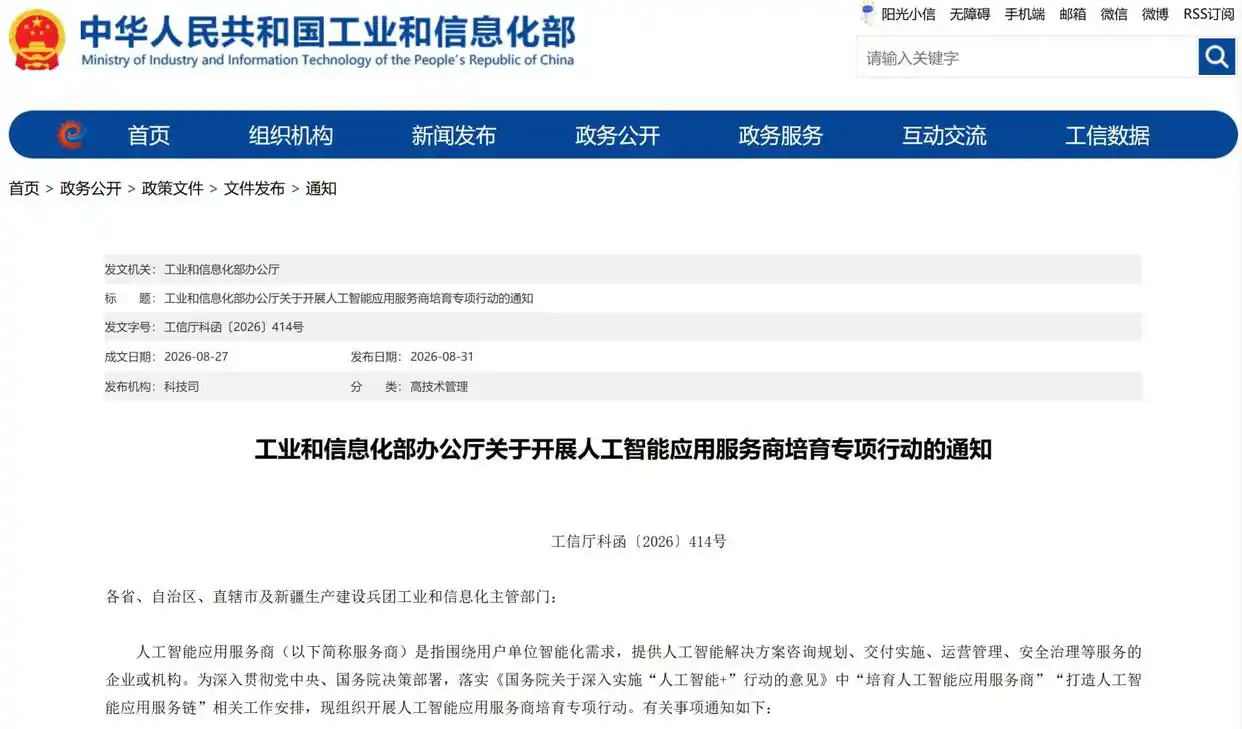
A role that was often overshadowed by models, computing power and agents has been placed front and center on its own — the artificial intelligence application service provider.
According to the plan, by the end of 2026, the number of enterprises in the national service provider resource pool will exceed 2,000; by the end of 2027, no fewer than 3,000. Localities are also to form "artificial intelligence application service teams," open up real-world scenarios, promote first-purchase and first-use, and explicitly propose stepping up procurement of services such as large models, agents and Tokens.
Why at this time?
The answer lies in the AI applications of the past two years.
More and more models, yet enterprises still find it hard to actually put them to use
Today, an enterprise that wants to adopt AI already has a very rich set of models to choose from.
Once it truly enters business operations, the problems often have only just begun.
How to connect with existing systems, how to use enterprise data securely, which model is more suitable, how to evaluate results after launch, how to control costs, who handles problems when they arise — these things are hard to solve directly by purchasing a model.
MIIT defines AI application service providers in specific terms: they address client organizations' AI adoption needs by providing solution consulting and planning, delivery and implementation, operations management, and security governance.
In language more familiar to enterprises, it means someone takes an AI project from the requirements stage all the way through to stable operation.
This is also a clear signal sent by this special action: as the supply of foundation models rapidly becomes richer, the AI industry is placing more attention on delivery and application.
Behind the 3,000 figure lies a new AI service chain
If one looks only at "3,000," it is easy to understand this action as expanding the number of enterprises.
Looking carefully at the notice, the policy is in fact building a new way of organizing the industry.
The first step is to establish a national pool of service providers so that the market can identify companies capable of delivering AI projects. Ongoing evaluation will create different tiers of service providers.
More noteworthy is the "artificial intelligence application service team."
The notice proposes that one service provider take the lead and join with model, computing power, basic software and hardware, and industry units to provide integrated solutions. In principle, each region shall submit no fewer than 10 service teams.
This fits the reality of enterprise AI projects well.
A complex project usually does not need only one model company. Computing power, data, models, security and industry systems may all involve different specialized teams. In the future, service providers will act more like a "general contractor" standing in front of the customer, understanding business needs and then organizing the technical capabilities behind them to complete delivery together.
MIIT also calls for packaging solutions for frequent, essential and reusable business needs into standardized products that are small, fast, lightweight and targeted, and continually validating them in real-world scenarios.
AI applications thus begin to have a clearer path to productization.
More noteworthy is that "how to buy AI" is starting to change
There is another sentence in this policy worth noting:
Explore models such as first-purchase and first-use and risk compensation, and step up procurement of services such as large models, agents and Tokens.
In the past, when enterprises procured AI, the common forms were software licensing, project construction or integrated software-hardware appliances.
As model services and agents gradually enter business operations, the object of procurement is also beginning to change.
In the future, enterprises may buy model capabilities by Token, call agents according to business needs, or directly procure a continuously running AI service.
This means AI services are starting to move from one-off projects toward more possibilities of charging by usage, operating results and continuous operations.
For AI vendors, the business model also changes accordingly: after the technology is built, they must also consider how to continuously serve customers.
A real-world sample is emerging in Wuhan
Not long ago, the Wuhan Computing Public Service Platform 3.0 was officially launched, and CloudWalk Technology completed an industrial cooperation signing, becoming a platform service provider and offering large model training, AIGC applications and agent-related services to enterprises across the city.
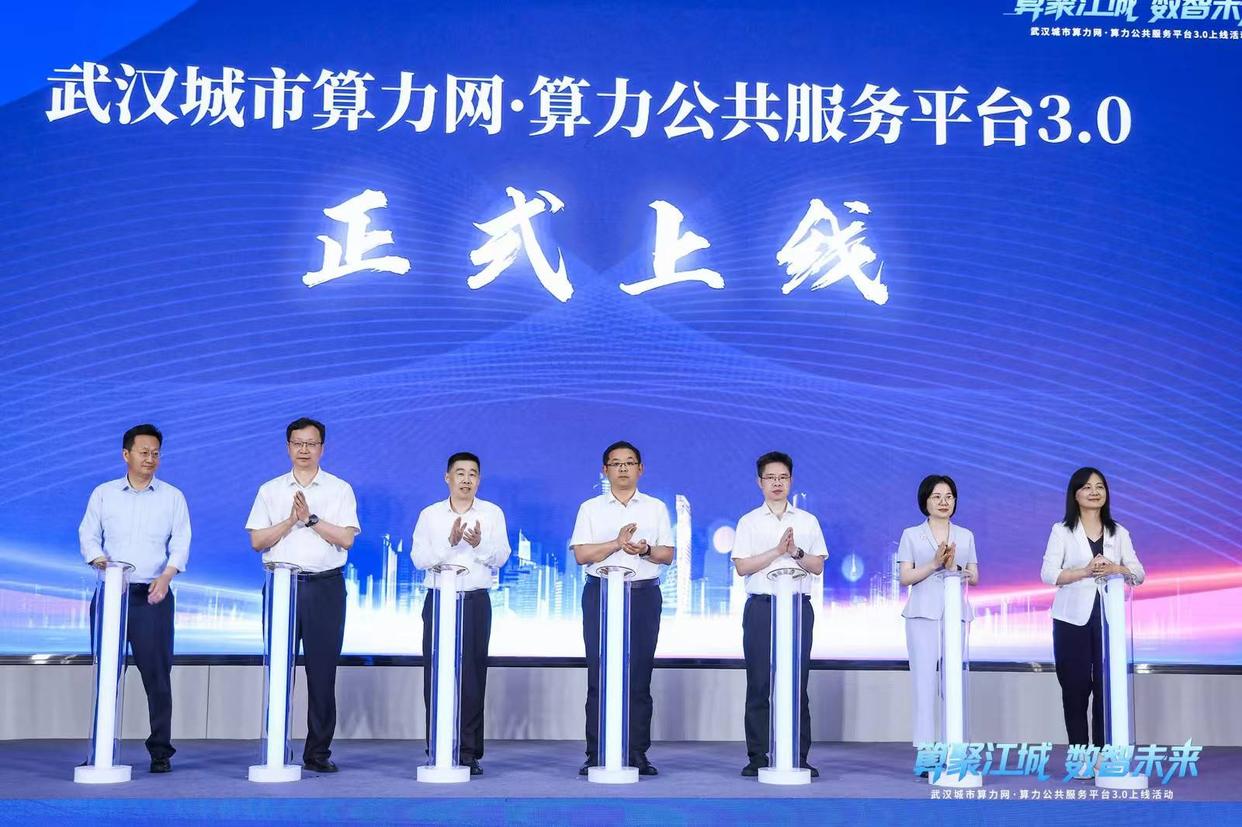
Wuhan Computing Public Service Platform 3.0 officially launched

CloudWalk Technology, on behalf of the National Cybersecurity Base Intelligent Computing Center, completed an industrial cooperation signing
This offers a clear example of how the service model can work in practice.
The Wuhan Computing Public Service Platform connects city-level enterprise demand; CloudWalk has already laid out in Wuhan a large model integrated model training and inference center and a controlled training ground based on trusted data spaces, and is jointly advancing the industrialization of the National AIGC Large Model Public Service Platform with the China Academy of Information and Communications Technology. After becoming a platform service provider, these capabilities have a more direct entry point for enterprise services.
If an enterprise has model training needs, it can seek training and validation environments; if it has AIGC application needs, it can call the corresponding platform capabilities; as its business further moves toward agents, it can also continue to access development and operation services.
The public platform is responsible for connecting demand, and professional service providers are responsible for solving problems — this is exactly the service chain the policy hopes to form.
Agents will take service providers deeper
As AI begins to participate in specific work, the problems service providers must solve will also reach further into the interior of enterprises.
In the product system CloudWalk is currently building, the underlying AI infrastructure provides models, computing power, data and training environments; the Xingyun Agentic OS and Mofang Agent Lab support the organization, construction and operation of agents; and above that, AI teams and virtual organizations are formed for specific business.
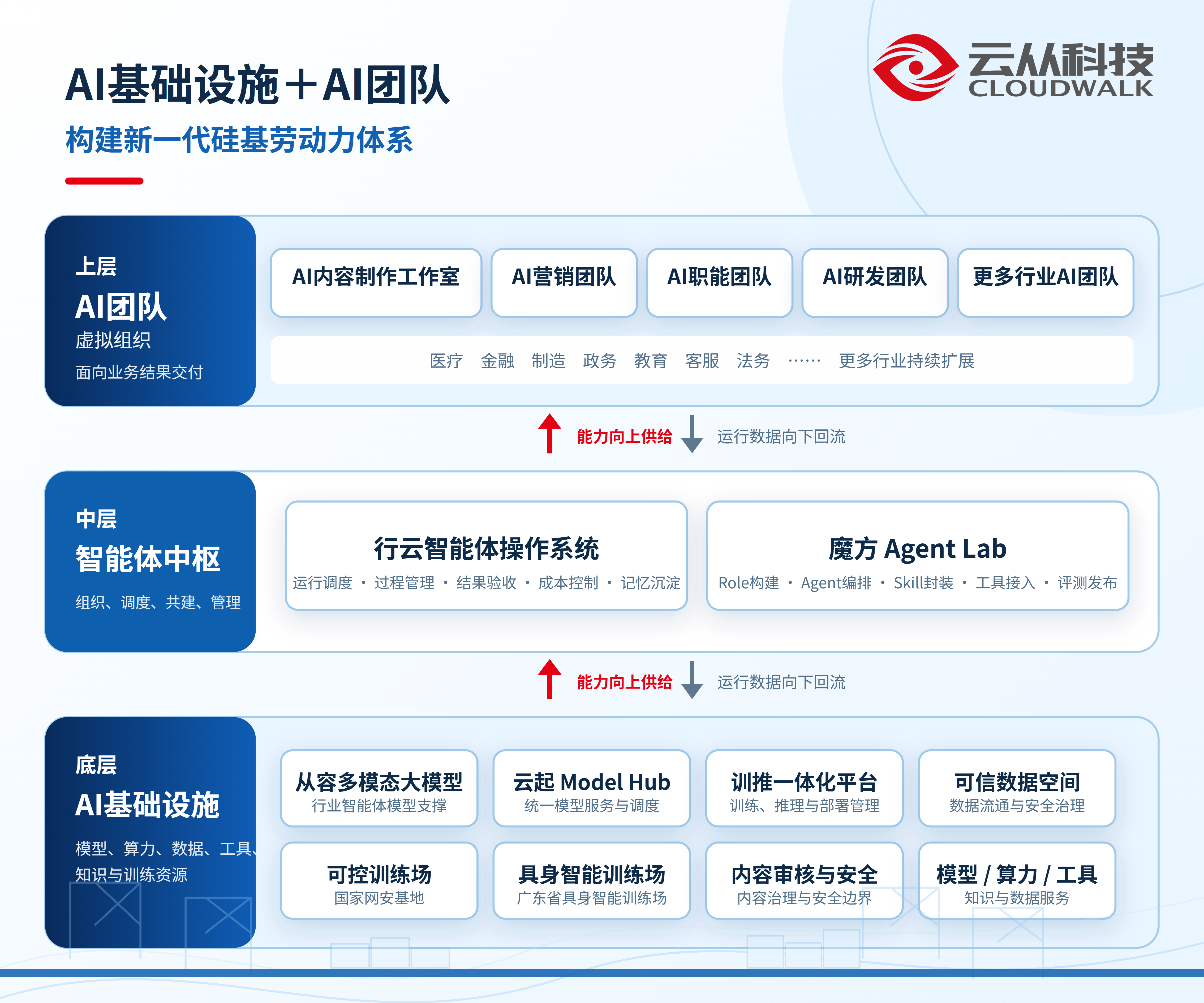
In real enterprises, delivery goals will become increasingly specific.
A cross-border business team may want AI to continuously handle market information and operational tasks; an instant retail enterprise focuses on operational efficiency; a content production team cares about whether an AI production line can work stably over the long term.
Ultimately, what measures a service provider will also come closer and closer to traditional business metrics: whether efficiency has improved, whether costs have fallen, and whether the system can run over the long term.
Service providers may become a key role in the large-scale deployment of AI
Over the past few years, China's AI industry has rapidly filled in the supply of models and computing power.
In the next stage, a large number of enterprises will face another question: how can these capabilities be conveniently purchased, and how can they truly be installed into their own business?
This special action gives a very clear direction.
Establish a resource pool so that excellent service providers can be found; form service teams to organize different technical capabilities; open up real-world scenarios to test results through projects; and procure large models, agents and Tokens so that mature capabilities generate market revenue.
Once this chain runs smoothly, AI applications will have the opportunity to gradually form replicable industrial services, moving beyond one-off customized projects.
A service provider signing on the Wuhan Computing Public Service Platform is just one entry point.
As more cities establish public service entry points and more enterprises open up real demand, a group of AI application service providers that truly understand business, can organize technology and can bear delivery responsibility over the long term may become an important force connecting models with thousands of industries.
Model capabilities will continue to advance. Next, who can reliably deliver these capabilities into business operations is becoming increasingly important.
You May Be Interested In
-
 2023-01-04
CloudWalk Technology signed a strategic cooperation agreement with Shenxin Kechuang. As leading domestic AI and autonomous driving companies, the two parties will reach numerous close collaborations in the following pan-mobility fields.
-
 2025-10-28
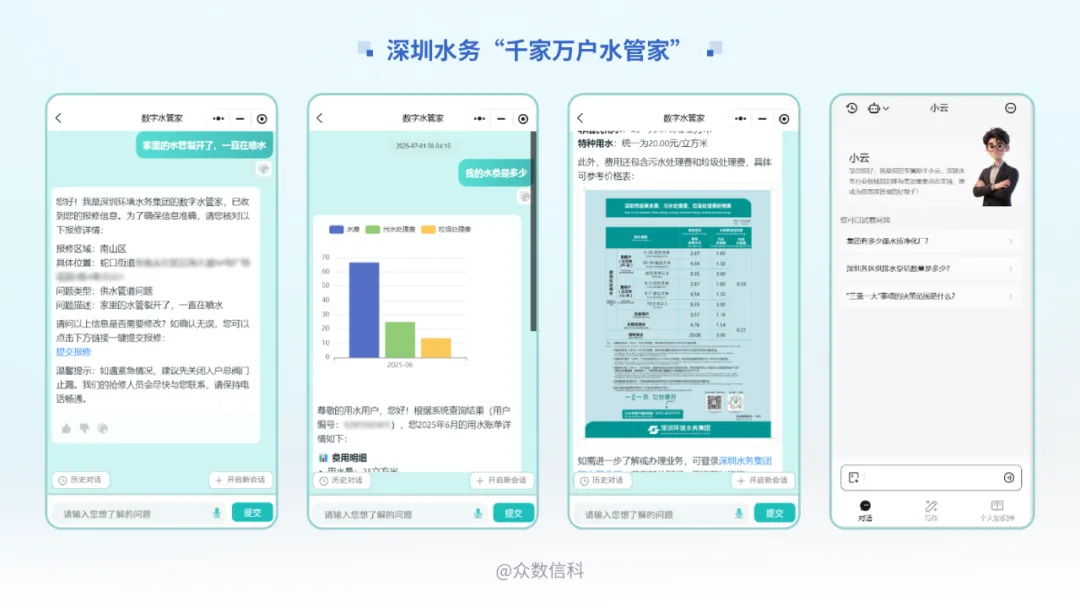
As a leader in enterprise-level AI agent infrastructure and services, CloudWalk Technology's subsidiary Zhongshu Information Technology, together with Shenzhen Environmental Water Group (hereinafter referred to as "Shenzhen Water"), has provided an innovative answer—jointly building the "Thousands of Households Water Steward" agent! This agent covers 459 water stewards, 7,160 communities, and 3.22 million users, building a smart service ecosystem that synergizes users, water stewards, and managers, achieving a comprehensive upgrade from "proactive service" to "intelligent service"!
-
 Free trial before March 31! Dongxihu District launches DeepSeek-powered Intelligent Computing Center2025-02-20
"In the past, using AI for enterprises was like building an airplane; now it's like playing with building blocks." Recently, the National Cybersecurity Base Intelligent Computing Center located in Dongxihu District announced the official launch of the DeepSeek large model platform, marking the formation of the center's trinity ecosystem of "computing infrastructure + top-tier models + scenario applications."